
Rooted Interests with
Frank Byrne, MD
Frank Byrne, MD
Rooted Interests with
Frank Byrne, MD
Frank Byrne, MD
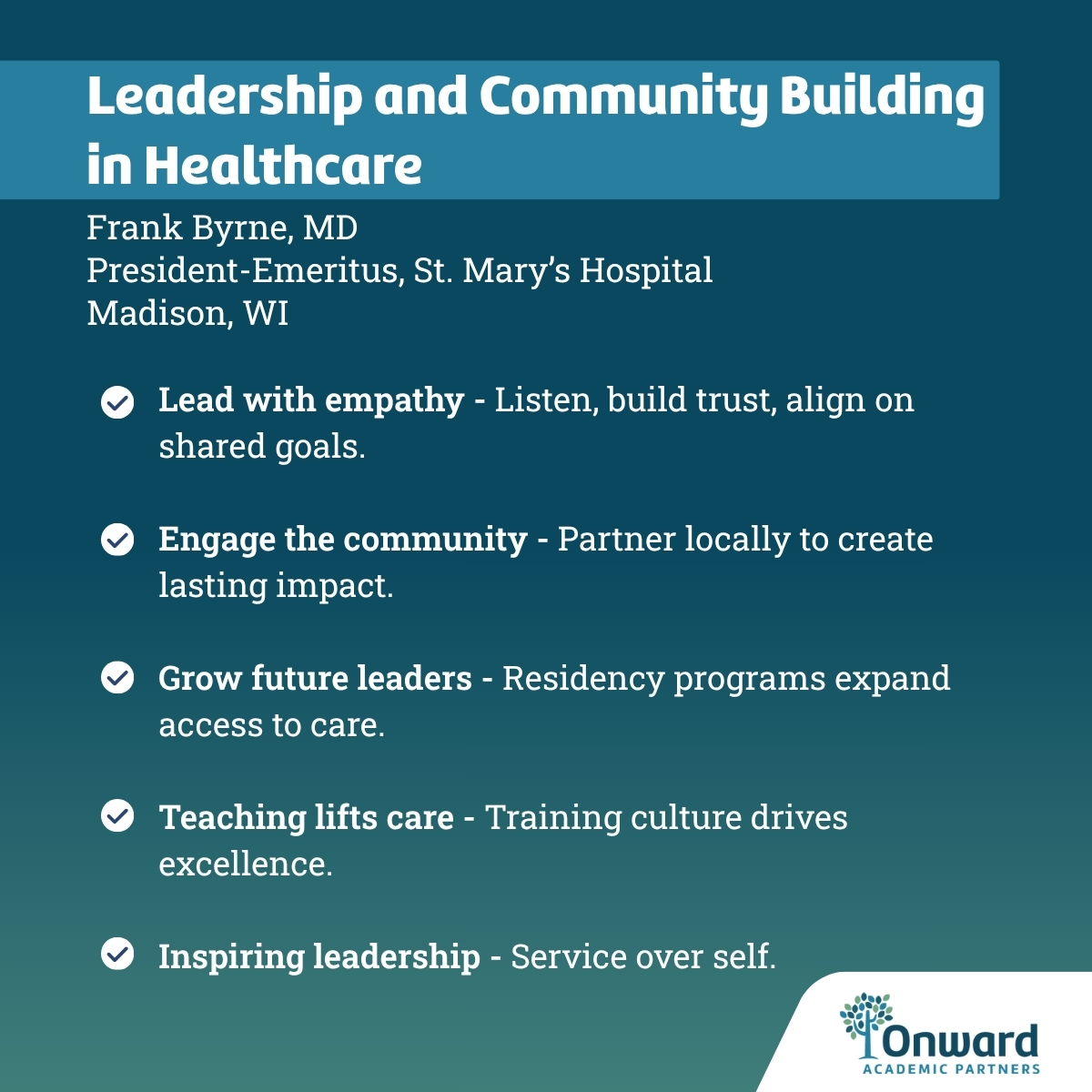
Leadership and Community Building in Healthcare
Onward Academic Partners recently had the opportunity to speak with Frank Byrne, MD, President-Emeritus of St. Mary’s Hospital in Madison, Wisconsin.
Our conversation explored leadership and the vital role community plays in shaping healthcare. Dr. Byrne emphasized that strong leadership is less about having all the answers and more about building trust, listening with empathy and working toward shared goals. Just as important, he highlighted how community engagement drives growth, whether through career development opportunities, collaborative teaching environments or initiatives that are targeted at improving patient experience. When organizations engage with the people they serve, the result is not only stronger institutions, but healthier communities.
With that perspective in mind, we asked Dr. Byrne to reflect on his leadership journey, the influence of community engagement and the lessons he carries forward.
This is part one of a two-part interview with Dr. Frank Byrne. Part two can be read here.
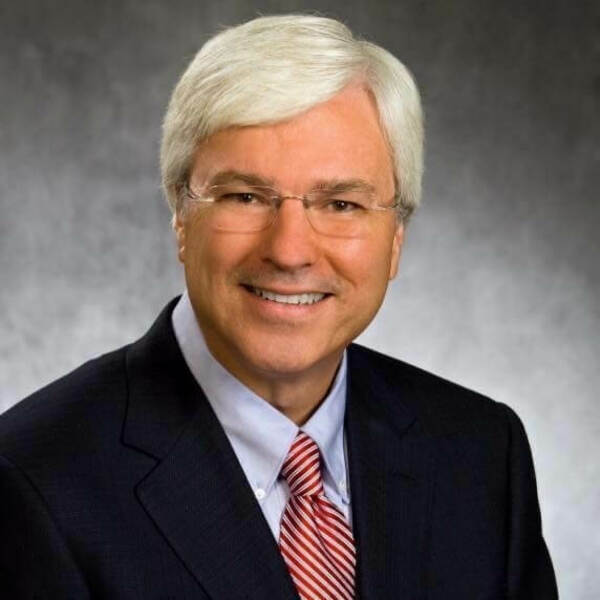
Dr. Frank Byrne
How has your leadership style evolved over your career? What leaders inspire you?
I believe you should first try to understand, then to be understood. Listen with empathy. In leadership, you cannot overplay the importance of developing relationships and building trust, whether it’s with business partners, your own team, or frontline staff. Focus on being a better listener and being transparent. Turns out, most people are reasonable. Leadership is not about pleasing everybody, it’s about finding mutual goals and agreeing on a path to get there. One of the people who really influenced me early in my leadership career was Quint Studer. He emphasized that healthcare is a service industry, and service excellence is the right thing to do.
Here in Madison, I’ve had the pleasure of working closely with Ruben Anthony, the CEO of Urban League. Ruben is a community-builder and leader who listens, collaborates, and focuses on partnerships that elevate other people and not just himself. When leaders lead for the benefit of others, that is what inspires me. When people lead for themselves and what they can get out of it, that’s not inspiring. I also admire Judy Falkner, the Founder and CEO of Epic, one of the most visionary leaders around. The culture she perpetuates is: what are we doing today to make healthcare more efficient and safe? They developed a model for the benefit of everyone, not just themselves.. Companies go public, sell to private equity, and cash out. That’s one approach, but Judy has set it up so Epic will never be like that. She is the most customer-focused person I have met.
How did you foster relationships and partnerships within the community to support the hospital’s growth? Is there an example of how community input changed the hospital’s approach?
You need to get out of your office and meet people where they are. Don’t wait for them to come to you. Attend community events, there are many great things happening at the Urban League and the Black Business Hub here in Madison. We are very open to partnering, which makes us all stronger. We partnered with the Urban League on their vocational development program, which included many entry-level healthcare jobs. We partnered with our general contractors who train others to build their skills. We also partnered to provide the most cost-effective healthcare intervention: prenatal care to women, thanks to those community connections. We had a neighborhood advisory committee that helped bring about change, which included the three neighborhood associations around the hospital. They proposed safety measures such as installing left-turn arrows at the entrance to the parking lot.. Community input is so important. I am very proud of the prenatal care because we did it with the trust of the people we were trying to reach in the community.
“We have an obligation to train our successors. It is a noble tradition in many professions including medicine, nursing, and law. One of the things that changes your life for the better is people who believe in you before you believe in yourself.”
What motivated you to establish a family medicine residency site? How did you measure its success?
The UW Department of Family Medicine was hosted at St Mary’s since its inception, so I didn’t establish it, St Mary’s did. My predecessor, once removed, Sister Rebecca, has been described by many as a visionary health leader. Family Medicine was just starting as a specialty at the time, and it seems to have performed better in community settings rather than purely academic settings. Sister Rebecca partnered with pediatric nephrologist Dr. Mark Hansen and state legislator Tommy Thompson, who was the longest-serving governor in the state’s history and Secretary of Health and Human Services. Tommy worked to get a line item in the budget to fund family medicine. Sister Rebecca said we’ll host it at St. Mary’s, and all the money will go to the residency with a small amount for administration and rent. That became one of the top-ranked family medicine programs in the country recognized for the quality of its residents. How do we measure its success? There aren’t necessarily quantitative things. You survey the residents, look at the national rankings, clinical outcomes, and patient satisfaction and engagement. The reason to have a family medicine program is to provide people access to the health system, which is tough to navigate. You need an advocate if you are too sick to advocate for yourself. Strong primary care relationships are crucial. We need new models that are more efficient and reach a broader part of the community.
How did the presence of a family medicine residency program influence the hospital’s culture, patient care, and reputation in the community?
We have an obligation to train our successors. It is a noble tradition in many professions, including medicine, nursing, and law. One of the things that changes your life for the better is people who believe in you before you believe in yourself. Throughout my career, when I was struggling with imposter syndrome and unsure of my place, it was teachers who encouraged me. And collaboration enhances teaching, being a teaching hospital enhances your reputation since it requires your staff to bring their A-game. Teaching makes you better and helps you stay current with the latest developments. Collaboration with the nurses is very important. If people understand that you’re really listening that you respect and trust them, they will tell you what you need to hear. Unfortunately, many leaders have only sycophants around them, telling them what they think they want to hear. We had town hall meetings every quarter that were open to all topics. I used to host an event every month called Breakfast with Business, with 20 to 35 community leaders in all levels of an organization, not just CEOs. We talk about a whole range of topics and problem-solve together. This fostered an inclusive and collaborative environment that helped us excel.
Rooted Insights is an engaging interview series that brings you candid conversations with some of the most dynamic leaders in academic medical administration. Over the years, I’ve had the privilege of learning from and collaborating with these remarkable individuals, and now, we’re sharing their insights and experiences directly with you.
Each interview offers a concise yet impactful perspective on timely and relevant issues in their area of expertise across academic medicine. Whether seeking new ideas, professional inspiration, or development guidance, these conversations are designed to spark your curiosity.
If you’d like to dive deeper, please contact me directly and we can continue the conversation.
Sit back and enjoy this series!