
Rooted Insights with
Jared Dashevsky, MD, MEng
Jared Dashevsky, MD, MEng
Rooted Insights with
Jared Dashevsky, MD, MEng
Jared Dashevsky, MD, MEng
Bridging the gap: How systems engineering and AI are redefining modern healthcare
This Rooted Insights interview features an in-depth discussion with Jared Dashevsky, MD, MEng, who currently serves as a Resident Physician at Mt. Sinai in New York City and is the founder of Healthcare Huddle.
Dr. Jared Dashevsky brings a unique, dual-perspective approach to the conversation, bridging the gap between frontline clinical medicine at Mt. Sinai and the complex macro-forces of the broader industry. As a physician and the founder of Healthcare Huddle, he has spent over half a decade translating the complexities of healthcare policy, business and technology into actionable insights for thousands of medical professionals.
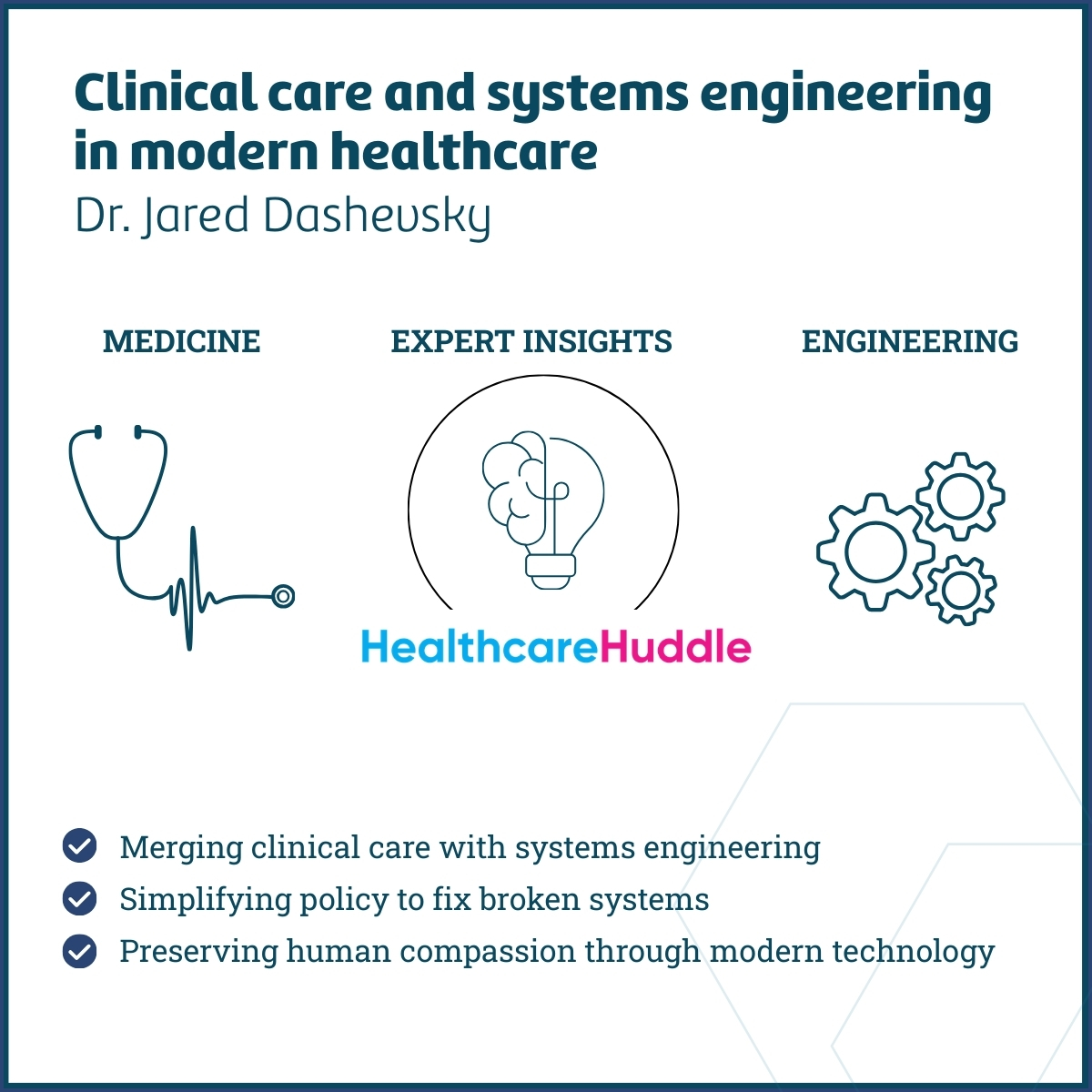
Our conversation reflects Dr. Dashevsky’s commitment to “connecting the dots” of a fragmented system. Throughout the discussion, he addresses the friction between clinical care and systemic inefficiency, offering a roadmap for how clinicians can better understand insurance, reimbursement, and digital health. By applying his background in healthcare systems engineering to the challenges of modern medicine, he identifies key opportunities for innovation and remains dedicated to building a foundation that empowers practitioners not just to navigate the system, but to fix it.

Dr. Jared Dashevsky
What initially drew you to healthcare? How have your career goals shifted since completing medical school?
Bridging clinical care and systems engineering
In middle school, I wrote in my yearbook that I wanted to be an orthopedic surgeon. I think my best friend’s dad was an orthopedic surgeon. Then, when I was in college, I had the opportunity to get a master’s in healthcare systems engineering, which combined industrial systems engineering techniques and methodology and applied them to healthcare. I wanted to do medicine and clinical care, but I was also interested in how systems work. Emergency medicine intrigued me because it’s fun and high energy, and I could apply my healthcare systems engineering knowledge to improve systems. Emergency medicine doctors do a lot of triage, but I like the part after triage, when you consider: Why does this patient have this awful pneumonia? Why is this patient in forward renal failure? I knew I wanted to do something that is one foot in clinical care and another in systems design and improvement.
Can you share the background on why you created the Healthcare Huddle and how you found the time to do this as a medical student?
The Evolution of Healthcare Huddle
During my master’s program in healthcare systems engineering, I became aware of how broken and inefficient our healthcare system is. I wanted to share knowledge with my peers and try to problem-solve insurance and digital health reimbursement. If you want to be a great physician, you should understand what’s impacting patients far from the bedside and that includes insurance, medication affordability, and access to fresh foods. I created a weekly newsletter that would break down healthcare news and trends. Then, the pandemic hit, and people needed a source of information. I started to build a team when everything was remote. It was a lot of fun, and I’ve just continued it since. We recently celebrated its 6th year anniversary. It’s gotten easier to do over time as I have accumulated more knowledge. It is time-consuming, but I like to think of it as brushing my teeth at this point. It just gets done.
What are the biggest challenges you’ve faced in communicating complicated healthcare issues to broad audiences?
The Art of simplifying systematic complexity
Healthcare is very complex. The hardest thing is: How much do I simplify it for the reader? What do I need to write to make the topic understandable to a non-expert? I am big on efficiency, so I don’t want anyone bogged down in unnecessary details. For example, I recently wrote about Trump RX. He launched it because drug prices are so high. To understand why drug prices are so high, you need to understand the patent system in the United States and how we front-load the cost of R&D. You also need to understand the rebate system and pharmacy benefit managers. I dig deep and then distill it all.
Fast forward…what does a “typical” medical school curriculum look like in 3 years?
Future medical school AI curriculum
Schools should undoubtedly be incorporating responsible use of AI to help guide medical education. Medical school is where you start developing your clinical habits. If there are no AI guardrails, you have no idea how to responsibly use it. A lot of what you learn in medical school is how to take a history and interview a patient, and how to use that information with objective laboratory data to create an assessment and plan. Those skills require practice and are what makes a clinician a clinician. Medicine is an art. Excellent bedside manner and being able to ask the right questions are the things that will separate clinicians from an AI robot in the future.
In what ways can healthcare be redesigned using AI tools to encourage better
patient outcomes and reward collaboration among their physicians?
AI healthcare systems redesign
We are at a turning point because we have all these wonderful AI tools coming out for the health system, physicians, and patients. From a systems perspective, AI can help increase revenue by decreasing the need for human labor when it comes to billing and quality review metrics. AI can comb through charts and figure out what needs to be billed for. Did the patient come in sicker than we thought and we can get higher reimbursement? Right now it’s all human driven. For the physician, AI can help with note-writing and pre-charting. You can give AI some patient data and it will summarize previous outpatient visits and hospitalizations, which saves a lot of time. AI can also help empower the patient and engage them in their care.
When it comes to technology, what do you think are the most glaring inefficiencies in U.S. healthcare delivery today?
Optimizing clinical workflow automation
Doctors spend a lot of time writing progress notes and discharge summaries. AI can automatically summarize a patient’s hospital course and transform it into a patient-friendly discharge so the patient understands everything. There might have been a unique finding that should be followed up with their primary care provider. AI can majorly help with time and efficiency. Another benefit is writing summaries in a patient’s native language, which will lead to better health outcomes.
How will AI impact a primary care office in 2027? Do you see more patients, especially baby boomers, using tools like ChatGPT or Perplexity?
Primary care trends
It depends how Perplexity and Open AI continue to roll out products. Open AI already said that they want to get into healthcare. I can imagine baby boomers going to AI to help them make sense of their labs and conditions, but also to better prepare for their visit, which is honestly where I could see a huge impact. AI can send a pre-visit message to the patient and suggest questions to ask the physician during their visit. The biggest bang for your buck for AI will be in the patient engagement space.
What is the AI tool you see with the most potential to impact physician burnout over the next couple years?
Ambient AI vs. clinician burnout
It will be the tool that solves the boring problems that occur repeatedly that lead to chronic fatigue. This includes note writing, billing, sending results, and responding to patient messages. These things compound over time and drive burnout.
What is the one aspect of providing healthcare that you wish more people understood well?
Preserving compassion in a technical world
I wish people understood that providing care is indeed an art. There are so many small soft skills you need to learn that contribute to the art of medicine. When you walk into the room and see a patient, are you talking down to them or taking a knee to get on their level? Do you place your hand on their lap when delivering bad news? Navigating those moments is crucial, and they are very hard to teach. It’s all about compassion. Even as technology continues to advance, I don’t want the art and compassion to be lost.
To stay ahead of the curve on healthcare policy, business, and technology, subscribe to Dr. Jared Dashevsky’s weekly insights at Healthcare Huddle.

Rooted Insights is an engaging interview series that brings you candid conversations with some of the most dynamic leaders in academic medical administration. Over the years, I’ve had the privilege of learning from and collaborating with these remarkable individuals, and now, we’re sharing their insights and experiences directly with you.
Each interview offers a concise yet impactful perspective on timely and relevant issues in their area of expertise across academic medicine. Whether seeking new ideas, professional inspiration, or development guidance, these conversations are designed to spark your curiosity.
If you’d like to dive deeper, please contact me directly and we can continue the conversation.
Sit back and enjoy this series!